

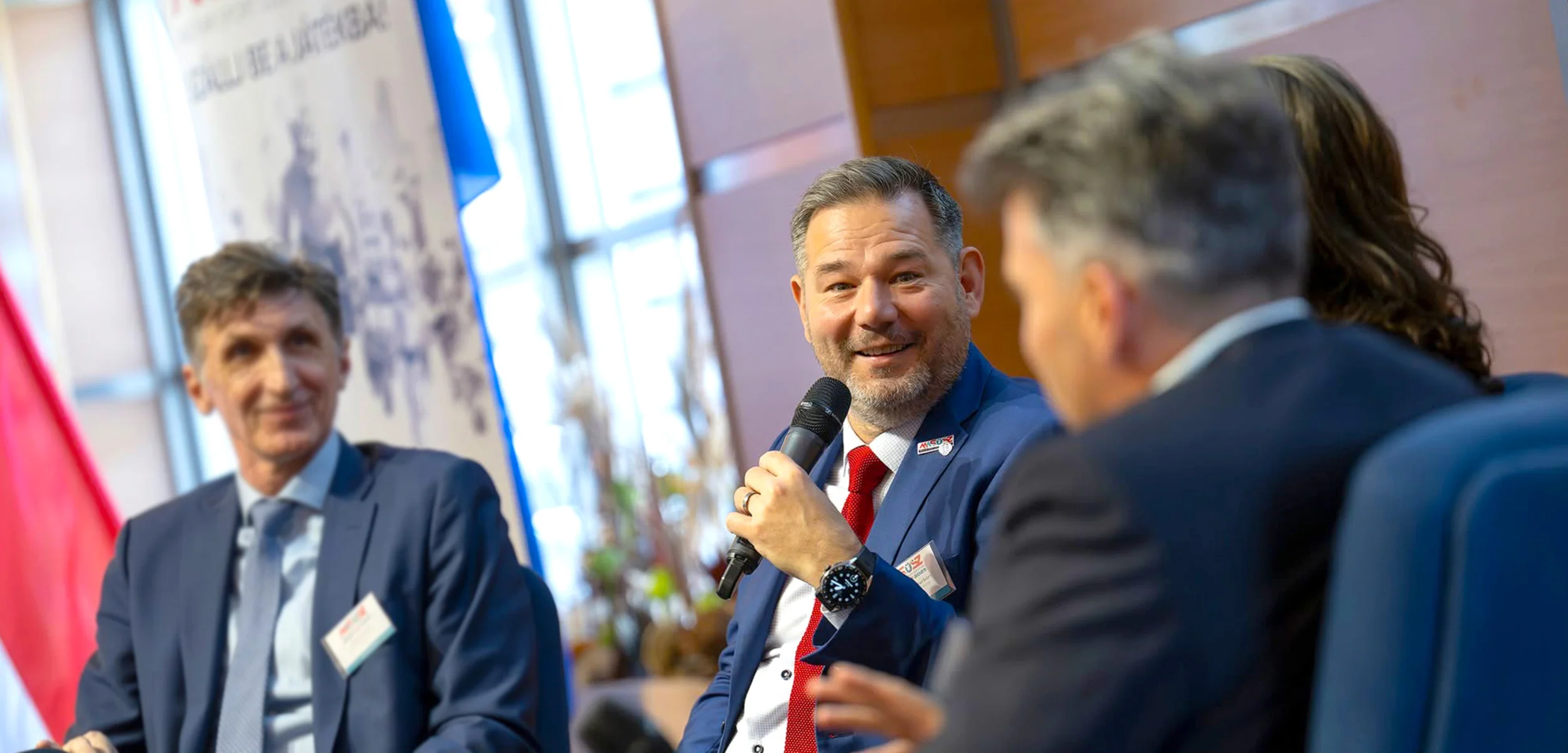
Sporting results alone are no longer enough for sport to succeed in the long run: it also takes responsible leadership, transparency and sustainable operations. We discussed this – and the key themes of the IV. MASÜSZ SportUp conference on 24 November – with Dr Norbert Rubicsek, member of the Hungarian Sport Business Association (MASÜSZ), Director of the CSCF Sport Integrity Group and an international sport integrity expert.
On 24 November, the Hungarian Sport Business Association will hold its fourth SportUp professional conference at the Hungarian House of Sports, centred on the SportESG360 Hungary® initiative. The programme puts the economic, social, human and governance dimensions of sustainability in sport at the forefront.
Building better sports organisations, not just better sport
Why does Hungarian sport need an initiative like SportESG360 Hungary® today?
Over the past twenty years, sport has developed enormously on the field, but the way sports organisations operate has not always kept pace with a changing world. Training well or competing well is no longer enough. A sports organisation also has to be safe, transparent, financially stable and socially credible. The MASÜSZ SportESG360 Hungary® framework represents exactly this shift in mindset: it sets out to build not just better sport, but better sports organisations.
How does this approach differ from a conventional ESG model?
Conventional ESG models were designed for companies, but sport works according to an entirely different logic. Here, trust, fair play, safeguarding, youth development and community building matter just as much as financial sustainability. The SportESG360 Hungary® framework does not simply apply ESG to sport; it builds a new way of thinking from the specific realities of sport itself.
Trust is the most valuable asset in sport integrity
Integrity and responsible governance are increasingly prominent topics internationally. What does all this mean for the day-to-day running of sports organisations?
Many people equate integrity with following the rules, but to my mind it goes much further than that. One of sport’s most valuable assets is trust – the trust that leads a parent to place their child in the care of a club, a sponsor to back an organisation, or a fan to believe in the performance they see on the field. Once that is lost, sport loses with it.
Leaders do not just make decisions; they create culture. They define the values an organisation runs on, how problems are handled, and what example is set for others. What distinguishes a successful sports organisation is not only its results, but also how it treats the people who make up that organisation.
Safeguarding athletes is another priority issue in international sport. How does the thinking of sports organisations need to change?
Developing outstanding athletes is no longer enough; you also have to create a safe environment for them. Safeguarding is not just another policy document or administrative obligation. It shows how far an organisation genuinely respects, protects and supports its athletes and everyone else in the sporting community. A safe sporting environment does not come down to the number of policies in place, but to organisational culture. The aim is an atmosphere in which every athlete knows they will be listened to, treated with respect, and will have someone to turn to if something goes wrong.
Sustainability is not only an environmental question
What is the biggest misconception about sustainability in sport?
That sustainability is purely an environmental matter. In sport, the sustainability of people, leadership and organisational operations is at least as important. A venue can be energy-efficient while the organisation inside it lacks trust or safety. For me, sustainability means that a sports organisation is able to build trust, develop and adapt to a changing environment over the long term. It is not only financial stability that counts, but also whether people genuinely want to belong to it.
What role can cooperation between sport and the business world play in this?
Professional sport is not only sport; it is also business. To be successful and credible in the long run, it needs the same foundations as any well-run company: good leadership, transparency, responsible decisions and strategic thinking. Experience from the business world can help sport build more professional organisations, while sport can give business back values such as perseverance, teamwork and fair dealing.
Hungarian sport needs to put more emphasis on developing organisations
Where does Hungary stand in international comparison today, and what changes are most needed?
Many good initiatives have been launched in Hungary in recent years, and in several areas the professional work already meets international standards. At the same time, world sport is changing extremely fast, so following the trends is not enough. Our goal should be to help shape international thinking ourselves in certain areas. I would like organisational development to become just as natural a part of sport as professional training. We put a great deal of work into developing athletes, but far less into developing the environment in which they train, compete and grow day after day.
What could be the greatest challenge for sports leaders in the coming years?
I believe the greatest challenge will be preserving trust. Expectations of sport keep rising, while the world changes faster than ever. The organisations that succeed will be those able to stay credible, keep developing and adapt to new challenges all at once. This rests on three pillars: trust, transparency and sustainable operation. And creating them is, above all, a leadership task.
IV. MASÜSZ SportUp – thinking together about the future of sport
The IV. MASÜSZ SportUp conference takes place on 24 November. What can participants expect, and why is it worth being there?
What my colleagues at the Association and I want is for participants to start thinking about sport differently. We did not set out to create just another conference, but a professional forum where the most important questions about the future of sport are put on the agenda. We talk not only about problems, but about solutions that work. The aim is for participants to go home with inspiration and practical ideas. The future of sport will not be shaped by a single organisation or a single profession. Sport, business, academia and decision-makers need to think about it together. SportUp is not only a conference; it is a meeting point for those who believe that Hungarian sport’s next great achievements can also be born off the field, in how its organisations develop.
The ideas set out by Dr Norbert Rubicsek also feature prominently in the programme of the IV. MASÜSZ SportUp professional conference, which begins at 10 a.m. on 24 November 2026 at the Hungarian House of Sports in Budapest.
Built on the SportESG360 Hungary® framework developed by the Hungarian Sport Business Association, the event examines the environmental, social and governance challenges facing sport within a single, integrated approach, paying particular attention to the practical and economic dimensions of sustainable operation.
The conference programme also gives a prominent role to the SportWellbeing360®, SportGrassroots360® and SportBusiness360® areas. The keynote presentations and interactive panel discussions create an opportunity for sports leaders, business professionals, decision-makers and representatives from across sport to seek solutions together to the challenges facing sports organisations.
MASÜSZ members can attend the conference with prior registration. For non-members, participation is available by purchasing a ticket.
Further information and registration: www.masusz.hu