
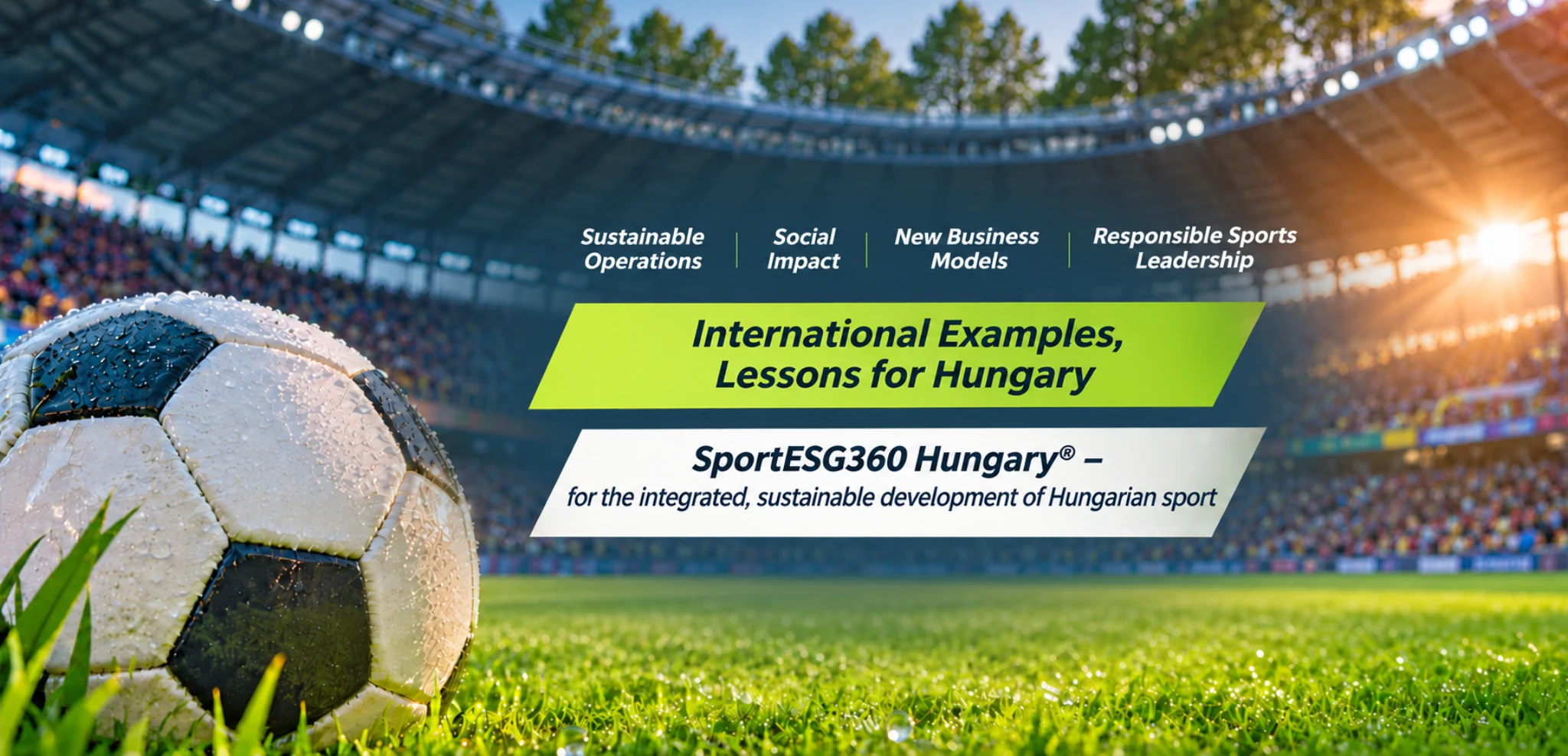
International examples and lessons for Hungary: sports business, social responsibility and sustainability are becoming increasingly interconnected.
The success of sports organisations is no longer determined solely by sporting results, financial performance or sponsorship revenue. Responsible governance, social impact, environmental sustainability and long-term value creation are becoming increasingly important.
The Institute for Sport Governance (ISG) highlighted a range of international best practices in its October 2026 professional review. These examples also offer valuable lessons for Hungarian sport and closely align with the integrated approach and established framework of the Hungarian Sport Business Association’s (MASÜSZ) SportESG360 Hungary® programme.
Sustainability must become part of sports organisations’ day-to-day operations
A growing body of evidence from the international sports sector shows that sustainability and individual environmental initiatives can no longer be treated as communication campaigns. They must become an integral part of organisational operations and strategic planning.
Italian football club Udinese has already piloted sustainable event-management solutions on several occasions. Its programme includes additional bus services, measures supporting bicycle travel, efforts to reduce food waste and improvements in accessibility. A distinctive feature of the initiative is the club’s commitment to measuring the outcomes of these measures, enabling it to continuously apply the lessons learned and share them across the international sports market.
Udinese is not alone in leading the way. Sustainability reports published by Borussia Dortmund, Bayern Munich and Inter Milan likewise show that assessing environmental and social performance is playing an increasingly prominent role in sport.
The international trend is clear: sustainability is no longer merely a commitment; it is also a measurable dimension of organisational performance.
The social impact of sport can also be expressed as measurable economic value
One area of sustainability that requires particularly long-term thinking is the social impact of sport and how that impact is measured.
According to the Formula E electric motor-racing championship’s 2024–2025 sustainability report, its social programmes reached more than 86,000 people, representing a 241% increase compared with the previous season. The championship worked with 960 local partners, while the estimated social value of its initiatives reached €5.6 million. Results of this kind introduce a new perspective to the sports economy. Sponsors and commercial partners increasingly expect the programmes they support not only to deliver visibility, but also to create genuine social value.
Community programmes, health promotion, equal opportunities and educational initiatives can therefore assume greater importance in sports business partnerships.
The social contribution of sport becomes truly assessable when we can present not only our objectives, but also the results achieved and their impact.
Climate change and sports infrastructure: new operating models and responses to emerging challenges
The effects of climate change are having an increasingly broad and direct impact on the operation of sports facilities, event management and the financial management of sports organisations.
Extreme weather, energy consumption, transport options and the cost of maintaining infrastructure all affect the long-term viability of sport. The renewed Sports for Climate Action framework developed by the United Nations climate change body therefore places emphasis not only on reducing emissions, but also on adaptation, collaboration and community engagement.
This area must also be a priority for smaller sports organisations, which often have limited financial resources for developing infrastructure or adapting to changing environmental conditions.
Sustainability is no longer solely an environmental responsibility. It has increasingly become an economic, investment and leadership issue that requires practical solutions and effective implementation.
Responsible sports leadership and youth development have gained importance in the 21st century
International professional initiatives are placing increasing emphasis on safeguarding children and young athletes, promoting equal opportunities, preventing discrimination and ensuring transparent governance within sports organisations. The Centre for Sport and Human Rights’ 2026–2030 strategy stresses that the positive social impact of sport cannot be taken for granted. Achieving it requires effective safeguarding mechanisms, responsible decision-making and accountable operations, supported by appropriately qualified professionals and adequate financial and economic resources.
An important lesson for Hungarian sport is that a sustainable sports ecosystem cannot be built solely around professional clubs and major sporting events. Youth development and safeguarding, recreational sport, local communities, supporter culture and stable operating systems all shape the long-term development and continued vitality of sport.
New business models, innovation and strategic sports management point the way forward
At the SPORTBIZ EUROPE 2026 conference in Barcelona, representatives of the international sports industry presented best practices covering new business models, the evolution of sponsorship, technological innovation and the challenges of strategic sports leadership.
Professional sports management is no longer concerned solely with increasing revenue. Alongside financial performance, responsible planning, risk management, organisational transparency and the development of long-term partnerships are becoming equally decisive.
Sports organisations increasingly need operating models capable of delivering financial stability, sporting success and social responsibility at the same time. Put simply, a purely sport-focused mindset must be complemented by a commercial and strategic outlook.
International experience, opportunities for Hungary – MASÜSZ SportESG360 Hungary®
The common lesson from international examples is that the sports economy, environmental sustainability, social responsibility and responsible governance cannot be addressed as separate, unrelated areas.
The Hungarian Sport Business Association’s SportESG360 Hungary® programme is built on this integrated approach.
The SportBusiness360®, SportWellbeing360® and SportGrassroots360® programmes connect the commercial operation of sport with the wellbeing of athletes and sports professionals, as well as the development of youth and community sport.
The objective is to establish a mindset and methodological framework that sports organisations can apply in their day-to-day operations, helping them align economic, social and environmental priorities.
Alongside learning from international best practices, it is equally important to examine how these solutions can be adapted to the specific characteristics of Hungarian sport.
IV. MASÜSZ SportUp – SportESG360®: from international lessons to practical solutions for Hungary
On 24 November, the Hungarian Sport Business Association will hold its fourth SportUp professional conference at the Hungarian House of Sports, with SportESG360 Hungary® as its central theme.
The professional programme aims to examine sustainability not merely as a theoretical concept, but as a practical issue that shapes the operation and development of sports organisations.
Through expert presentations and round-table discussions, Hungarian specialists will explore current challenges in the sports economy, social responsibility and responsible governance, drawing on both domestic and international examples.
Particular attention will be given to opportunities in sports financing and commercial operations, the wellbeing of people working in the sports sector, the development of youth and community sport, and the long-term sustainability of sports organisations.
SportUp aims to ensure that international trends and Hungarian experience lead not only to professional dialogue, but also to solutions that can be applied in practice.
One of the most important questions facing the future of sport is no longer simply how we can achieve better results, but also how we can create a sports environment that is sustainable, financially stable and socially valuable over the long term.
The IV. MASÜSZ SportUp conference is open to everyone. Subject to the participation terms, MASÜSZ members may attend free of charge with advance registration, while tickets are available to non-members. Further information and registration: www.masusz.hu.
Source: Institute for Sport Governance (ISG): October 2026 at ISG – Responsibility, Sustainability and the Future of Sport Management. This article draws on the ISG’s international professional review, highlighting conclusions relevant to Hungary’s sports industry and presenting the MASÜSZ SportESG360 Hungary® initiative.