

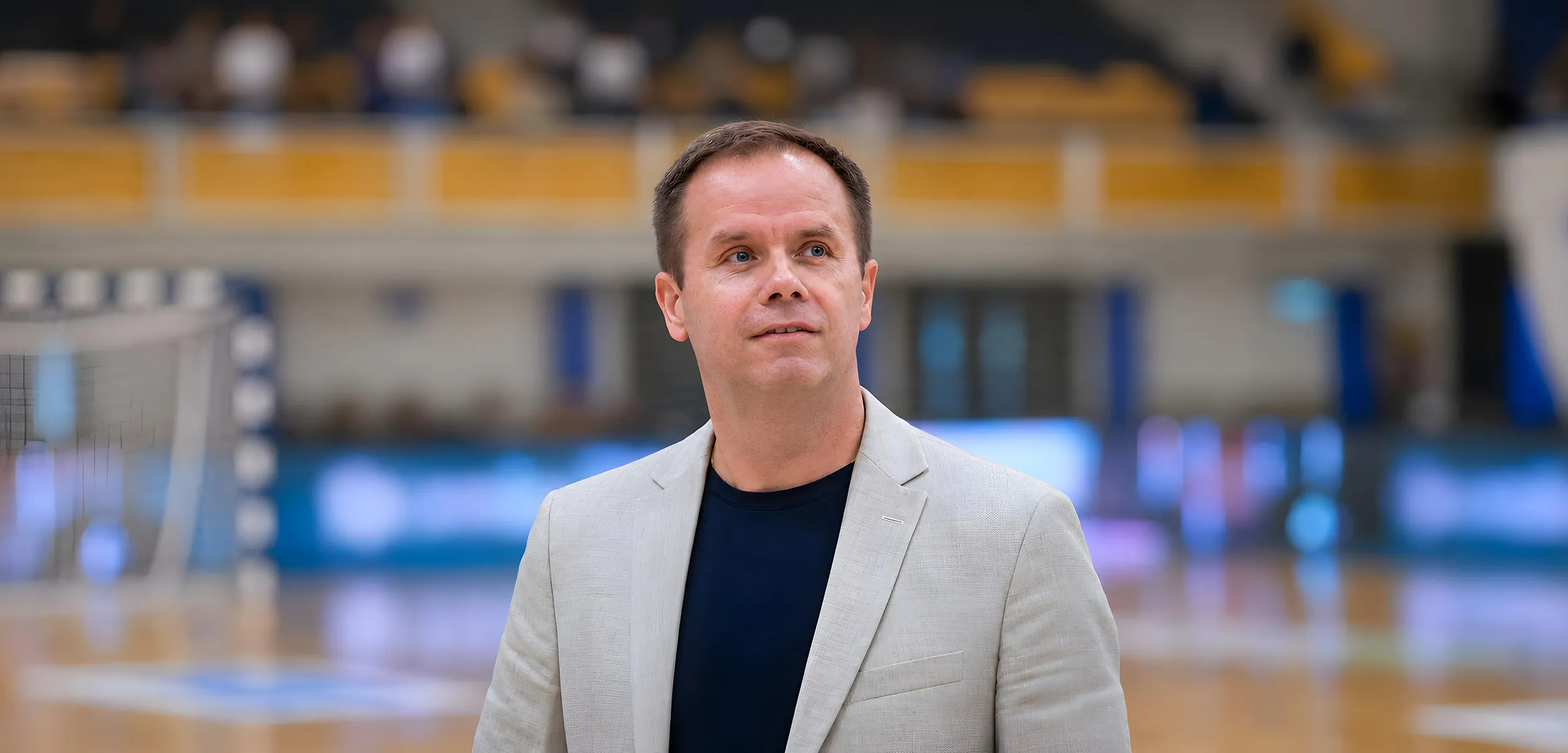
Sports infrastructure, sustainability and responsible operation – an interview with István Attila Kovács, President of Szigetszentmiklósi Kézilabda SK, ahead of the Hungarian Sport Business Association’s IV. MASÜSZ SportUp professional conference.
The sustainability of sports facilities now means far more than energy efficiency and lower running costs. Operating successfully over the long term calls for attention not only to the economics, but also to public access, community needs and responsible governance. This integrated approach is the foundation of the SportESG360 Hungary® framework developed by the Hungarian Sport Business Association (MASÜSZ), which examines sustainability in sport through its environmental, social and governance dimensions.
But how can these principles be applied in the day-to-day running of sports facilities? And how can a balance be struck between the demands of competitive sport, opportunities for community participation and financial sustainability?
We discussed these questions with István Attila Kovács, President of Szigetszentmiklósi Kézilabda SK and lecturer at the Institute of Health Promotion and Sport Sciences at ELTE PPK, who will also take part in one of the expert round tables at the IV. MASÜSZ SportUp conference on 24 November.
The biggest challenge: sustainable operation and wider access
You work in both the practical and the academic side of sport. Where do you see the greatest challenge for Hungarian sports infrastructure today?
It lies in operating our existing facilities sustainably over the long term while making regular physical activity accessible to more people. Competitive sport needs predictable training and competition slots in order to deliver results. Schools, youth programmes and recreational sport equally need times they can plan around.
Sports policy aimed at strengthening recreational participation will only be felt locally if, for example, someone who wants to exercise after work can find a suitable venue and time slot, can see the price in advance, and can book it easily. In facility management terms, that is a very concrete task.
After the investment phase, should more emphasis be placed on efficient operation?
Yes, and it needs to be taken into account as early as the investment decision. At the planning stage we should already know who will use the facility and how often, what operating solutions and costs to expect, and how future planned refurbishments will be funded.
Replacing a sports floor or overhauling a pool’s plant is both a financial and a sporting question. Scheduled in good time, schools, clubs and community users can plan around the closure. Preventive maintenance protects the value of sporting assets and the quality and continuity of the service alike.
Data-driven planning and SportESG360 Hungary® in daily operations
What principles would you build a national sports facility management strategy on?
I would collect the same core data for every facility: technical condition, capacity, actual usage, energy and water consumption, and costs and revenues.
I would match operational targets to each facility’s purpose. At an Olympic training centre, capacity planning is driven by the training conditions of national squads; at a teaching pool, by the continuity of swimming instruction and public access. The data also reveals where expansion is genuinely needed, and where more users could be accommodated simply by changing opening hours or the booking system.
How can the MASÜSZ SportESG360 Hungary® approach show up in day-to-day operations?
Take a teaching pool as an example. Environmental performance includes measuring water and energy consumption and matching the plant to actual demand, while maintaining water quality and safety.
Social performance shows in how many people, alongside school swimming lessons, get regular public swimming time, and whether athletes with disabilities can access the service.
Responsible governance shows in whether it is traceable who decides on lane allocation, pricing and discounts, and under what rules.
These three dimensions are best assessed together. If we open up more public swimming time, we need to know how many new users we reach, what the additional cost is, and how continuous operation can be maintained without a major increase in spending.
Where are the biggest financial reserves? Could you give an example?
Alongside efficient operation, I would look first at the sustainability opportunities. If only one section of a hall is regularly in use on weekday mornings, it is worth examining whether lighting and ventilation can be controlled zone by zone, or how the spare capacity could be filled.
From there you can measure how much adjusting those settings, or raising utilisation, saves while keeping service conditions unchanged.
For larger plant investments I would work with whole-life costs. There is room for improvement in procurement too, and ESG models can open up new opportunities.
Recurring needs can be planned ahead, approval times can be measured, and suppliers can be assessed on quality, deadlines and actual cost. All of this can help reduce both costs and operational risk.
Public service, financial sustainability and multifunctional operation
How can a public service remit be reconciled with financial sustainability?
The operator has to set its priorities in advance: what service it commits to, who it provides it for, and what delivering it costs.
If the goal is to expand community participation, that has to be visible in the usage schedule too – for instance through evening or weekend slots that can be booked regularly. Staffing, opening hours and operating funds have to be planned for these just as for every other task.
Renting out the remaining capacity and income from events can contribute to upkeep. The owner then has a clearer picture of what service is being funded, while users know on what terms they can access the facility, depending on available capacity.
What business opportunities do you see in multifunctional operation?
A sports facility can host training camps, amateur tournaments, corporate sports days or professional events.
For a local company, for example, an employee sports programme can be valuable in its own right and can form the basis of a longer-term partnership, which may later make it easier to bring that company into local sponsorship arrangements.
As an operator, for every event I look at what is left of the income once staffing, energy, cleaning and surface protection are paid for. I also check how the event fits the competition calendar and the publicly announced community slots.
Indicators and community value
What indicators show whether a sports facility is successful?
I look at actual utilisation, cost per hour of use, energy and water consumption, technical downtime and user satisfaction together.
Social outcomes include how many school groups, youth teams and community participants get regular access, and how many of the advertised slots are actually delivered.
The quality of governance is reflected in decision turnaround times, how complaints are handled and whether measures are carried out on schedule.
On that basis a manager can decide where opening hours, technical operation or the service itself need to change.
What makes a sports facility genuinely serve its local community?
The fact that people of different ages, with different reasons for taking part, can use it regularly.
A school needs slots that fit the timetable, an amateur team needs evening court time, a family needs a weekend option. Access also depends on pricing, barrier-free entry and use, and clear information.
I would agree requirements with local authorities, schools, clubs and recreational sports organisers before the season starts, which also helps secure funding for operating costs.
After that, the available slots, prices and booking terms would all be visible on an online booking platform, which improves both utilisation and the financial return on operation.
Which of your experiences in Szigetszentmiklós do you think could work elsewhere?
From our “Handball in Schools” partnership with the local school, I would highlight that school and club requirements can be aligned well in advance.
Regular sessions need an agreed time slot, a named professional lead and predictable funding. The same approach can be applied to community programmes.
A recurring local event, an amateur team or a community programme can only build community if participants can count on the same time and the same opportunities week after week.
Responsible governance and the shift in thinking that is needed
What does responsible governance mean in a sports organisation managing significant infrastructure and budgets?
That every significant decision has a named owner, a deadline and a verifiable rationale.
With a refurbishment or a procurement, it is traceable who raised the need, on what grounds the decision was made, and who signed off on delivery.
Faster decision-making comes from standardised documents, clear approval authorities and processing deadlines that are short but measurable.
It matters just as much that users know where to report a safety or access problem, and when they can expect a proper response.
Which three changes could deliver meaningful results within five years?
First, creating a common basis for measurement and planning. For every facility I would track technical condition, consumption, usage and costs, and build a multi-year maintenance and refurbishment plan on that.
Second, I would set up a single online booking platform where, alongside the periods reserved for competitive sport and public service obligations, the slots and prices available for community use are clearly visible and bookable.
Third, I would speed up procurement and decision-making. With an annual procurement plan, designated decision-makers and documented delivery, both speed and financial performance should be measurable.
What shift in thinking is most needed today?
We should judge the success of sports facilities by the service they sustain over time. That includes the conditions in which competitors can prepare, where children first encounter sport, and whether local people can find an activity that fits into their everyday lives. The value of a facility is also shown by how many people it gives regular opportunities to be active, whatever its status.
István Attila Kovács’s points illustrate clearly that the future of sports facilities depends not only on new investment, but also on how we manage existing infrastructure, how we secure its long-term sustainability, and what value we create for athletes, local communities and society. Financial efficiency, wider access and responsible operation together can define the next phase in the development of sports infrastructure.
This integrated approach is also at the heart of the Hungarian Sport Business Association’s IV. MASÜSZ SportUp professional conference on 24 November, which is built on the SportESG360 Hungary® framework developed by the Association.
Held at the Hungarian House of Sports, the conference examines the environmental (E), social (S) and governance (G) dimensions of sustainability, with particular attention to their practical and economic application in sport. The SportWellbeing360®, SportBusiness360® and SportGrassroots360® areas also feature prominently in the programme.
In the keynote presentations and interactive panel discussions, sports leaders, business professionals, decision-makers and corporate representatives will look together for answers on how sustainability can become an integral part of the everyday operation of sports organisations and facilities.
The IV. MASÜSZ SportUp professional conference takes place on 24 November 2026 from 10 a.m. at the Hungarian House of Sports in Budapest. MASÜSZ members can attend with prior registration, while non-members can join the event by purchasing a ticket.
Further information, registration and tickets: www.masusz.hu/sportup.html
IV. SportUp – The future of sports with a new perspective.